


20 Hours 40 Min - Our Flight In The Friendship
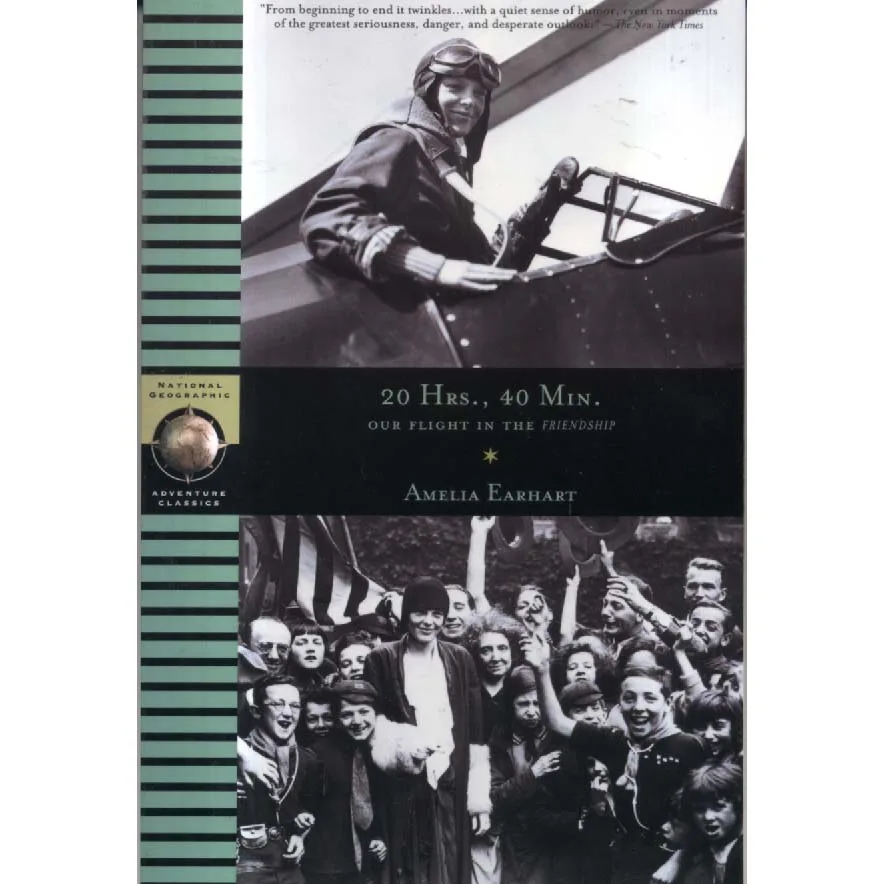
Publisher: National Geographic
Format: Paperback
ISBN: 9780792233763
In 1928, crossing the Atlantic by aeroplane was not yet a tiresome interval between buying perfume and waiting beside a baggage carousel. It was an undertaking involving unreliable weather reports, experimental machinery, primitive navigation and the distinct possibility that neither aircraft nor passengers would ever be seen again. Into this reassuring environment stepped Amelia Earhart.
20 Hrs., 40 Min.: Our Flight in the Friendship is Earhart’s own account of the transatlantic journey that made her internationally famous. Originally published in 1928 and reissued by National Geographic in 2003 for the flight’s seventy-fifth anniversary, it captures aviation at the wonderfully reckless stage when a successful landing still qualified as major international news.
The Friendship was a Fokker trimotor piloted by Wilmer “Bill” Stultz, with Louis “Slim” Gordon serving as mechanic and co-pilot. Earhart travelled as the third member of the crew and kept the flight log, becoming the first woman to cross the Atlantic by air. She later described herself, with characteristic honesty, as little more than “a sack of potatoes” during the crossing because she had not piloted the aircraft. It was possibly the most famous sack of potatoes of the twentieth century.
The aircraft departed from Trepassey Harbour in Newfoundland on 17 June 1928 and, following a long encounter with fog, wind, fuel calculations and the Atlantic Ocean, landed at Burry Port in South Wales. The journey took the celebrated twenty hours and forty minutes of the title—approximately the length of a modern budget-airline delay, but with considerably less certainty that refreshments would arrive.
Earhart combines a record of the flight with recollections of her childhood, her discovery of aviation and the unusual path that led her into the cockpit. She writes directly and without excessive heroics, conveying both the exhilaration of flying and the practical discomforts of early aircraft, which offered passengers all the luxury of a garden shed being pushed through a thunderstorm.
There are log entries made during the crossing, observations about the preparations and descriptions of the curious experience of becoming famous almost immediately upon landing. Earhart had crossed an ocean, reporters had acquired a story and the machinery of celebrity swung into action before anyone had been given sufficient time to find a hot bath.
Yet Earhart repeatedly acknowledges Stultz and Gordon, resisting attempts to present herself as the sole heroic figure. She knew that she had been selected partly because she was a woman who looked sufficiently like the recently celebrated Charles Lindbergh to be marketed as “Lady Lindy.” It was not the most subtle piece of publicity, but subtlety had apparently been left behind to save weight.
The book also considers women’s place in aviation at a time when many people regarded female pilots as an amusing temporary disturbance. Earhart discusses the obstacles they faced and argues for their participation with calm confidence. Her achievement may initially have depended upon being taken across the Atlantic by two male pilots, but she soon proved herself independently, becoming the first woman to fly solo across the Atlantic in 1932.
Read today, the book offers more than a narrative of one famous journey. It preserves the atmosphere of aviation’s pioneering age, when every long-distance flight was partly an engineering experiment, partly a publicity event and partly a spirited disagreement with mortality. Maps were basic, instruments limited and weather forecasting optimistic enough to qualify as fiction.
Earhart’s personality is present throughout: practical, modest, observant and quietly determined. The later mystery of her disappearance has inevitably overshadowed much of her life, but this book allows her to speak before legend swallowed the person. Here she is not a historical riddle or a face in a documentary; she is an ambitious young aviator considering what flight could mean for women and for a world suddenly becoming smaller.
This National Geographic Adventure Classics edition enhances Earhart’s original narrative with historic photographs and a specially prepared flight map, placing the journey in its geographical and technological context. It is therefore both an absorbing first-person memoir and an attractive piece of aviation history, suitable for readers who enjoy pioneering flight, remarkable women, travel writing and machinery held together by confidence.
It may also reassure nervous modern passengers. However unpleasant one’s flight becomes, it probably includes pressurisation, satellite navigation and a pilot who does not need to peer through fog in the hope that Wales will eventually appear.
This copy is in Good condition, showing normal evidence of previous ownership but remaining sound, presentable and perfectly fit for another transatlantic expedition from the safety of an armchair. No emergency flotation equipment is supplied or required.
Offered by Crappy Old Books, where all flights depart from the bookshelf, turbulence is generally mild and luggage allowance is determined entirely by how many books you can carry.
Keep browsing: See more History books Other books by Amelia Earhart
